If you work with me for any amount of time, you will quickly learn that I love a good 2×2 diagram. 2×2’s are great tools for all kinds of design activities, from tactical planning to explaining abstract concepts. Check out this 2 min. video on how I’ve used 2×2’s to develop personas, plan user research, and determine team priorities, or read my thoughts below.
VIDEO GOES HERE
Where it all began
This was the 2×2 that started it all for me. It’s not particularly pretty. It won’t pass accessibility guidelines for color contrast. But it changed the way I thought about communicating concepts.
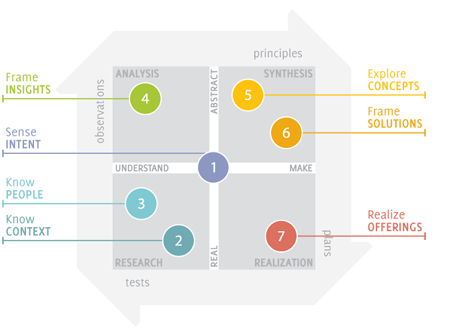
I first encountered this 2×2 in the first semester of my grad program, in a survey class outlining the human-centered design process. Besides the 2×2’s subject being the underpinning of my entire coursework, it also exemplified the power of diagrams for illustrating processes with multiple layers of abstraction, and that showed purpose and outcomes in a simple, elegant way.
Visual communication, especially using diagrams, was half the challenge of birthing any product that makes real change in the world. I grew to appreciate this often throughout my grad program, thanks in no small part to thinkers like Kim Erwin and Tomoko Ichikawa.
Since then, many opportunities have called for 2×2’s to show characteristics of factors in the design process, including developing personas, planning user research, and determining priorities.
Developing personas
Human-centered design activities typically begin with understanding users or customers. We interview people who use a product or service to identify barriers and service opportunities. As we analyze interview data, important cross-cutting user characteristics are revealed. These can become the axes on which to create a 2×2 matrix for developing personas. My work with asthma patients is a good example.
After interviewing sixteen kids and their families about how they manage their asthma, we noticed that kids could be divided into those who were much more proactive about their care than others. Also, some kids felt restricted in life by their asthma, while others felt more free about activities. These two characteristics became the basis for our user persona 2×2 diagram.
DIAGRAM HERE with link
When we plotted all sixteen of the kids on the 2×2, groups clearly emerged. These groups formed the basis of our personas. Later, we used what we learned from the kids in each group to develop four detailed personas that became targeted user groups.
PERSONA HERE with link
Sometimes, not everyone you interview falls neatly into one group. This happened on the asthma project, and my team decided to revisit the data to see if there was anything we missed. We debated other possibilities for describing people’s overarching characteristics, and eventually agreed our initial model was solid, and that we were okay having an outlier to the group. We didn’t ignore the outlier, since extreme use cases can be very informative, and reasoned that the outlier group might benefit from variations on solutions from other groups.
Planning user research
Sometimes, designers start out with an idea of the characteristics of the subject they want to learn more about, but want to ensure coverage in planning research. This was the case with my work with Steelcase, where we were investigating posture among people in a variety of office settings. We used a 2×2 to ensure our research was representative of a broad spectrum of office cultures, from small boutique companies to large multinational corporations, and from those with more creative attitudes to others with more traditional business culture.
DIAGRAM here
When we plotted research participants on the 2×2, it revealed that among our participants, none who were large avoided being more buttoned up. This led us to wonder why as we conducted interviews and later analyzed the data we collected. Was this a group to seek out for further insights, or do corporate cultures demand smaller scale relative to creativity? Answers to questions like this could have implications for how we approach designing solutions, and the questions were prompted by our use of 2×2’s.
Determining priorities
2×2’s are among several go-to tools I use for communicating visually.
Describing potential futures, distinguishing groups in insightful ways, and connecting the why with the what, became guiding principles of design for me.
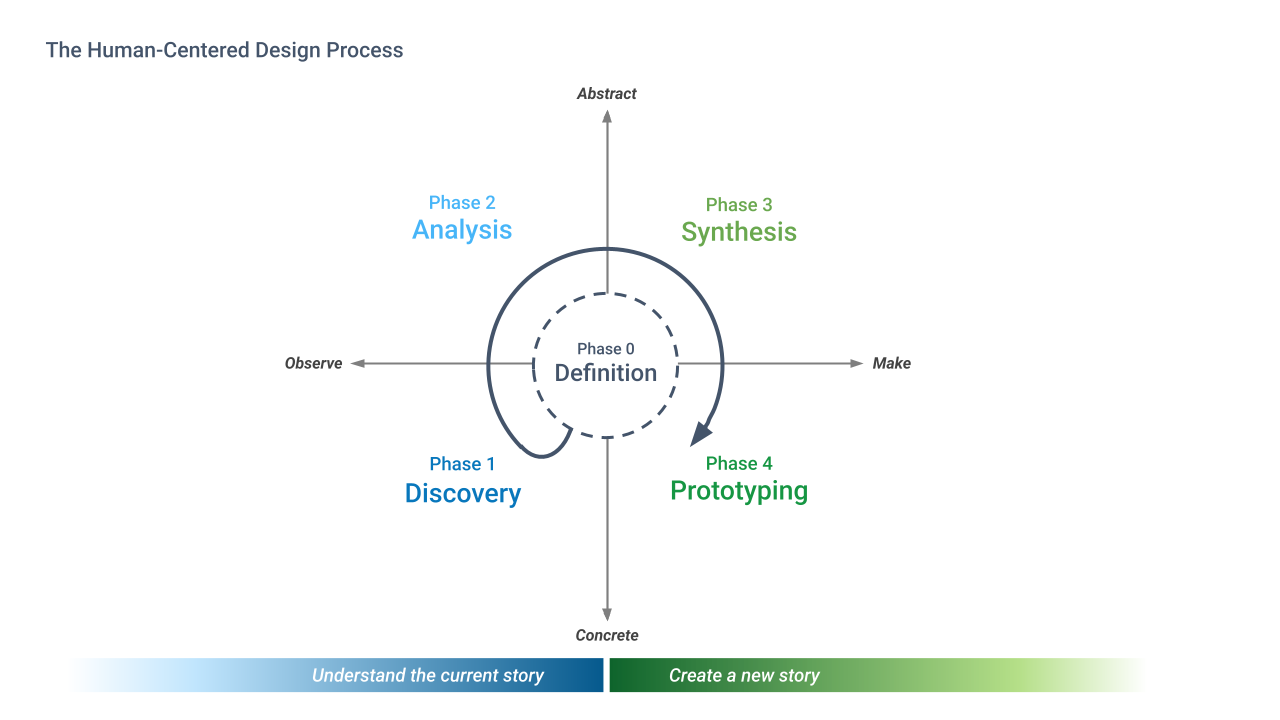


 Russell Flench